
Introduction
My whole family lives close to the land – and to each other – through the cycle of the seasons. My grandparents’ grandparents walked beside the same stream where I walk with my brother, and we can see what they saw.
p. 1-2
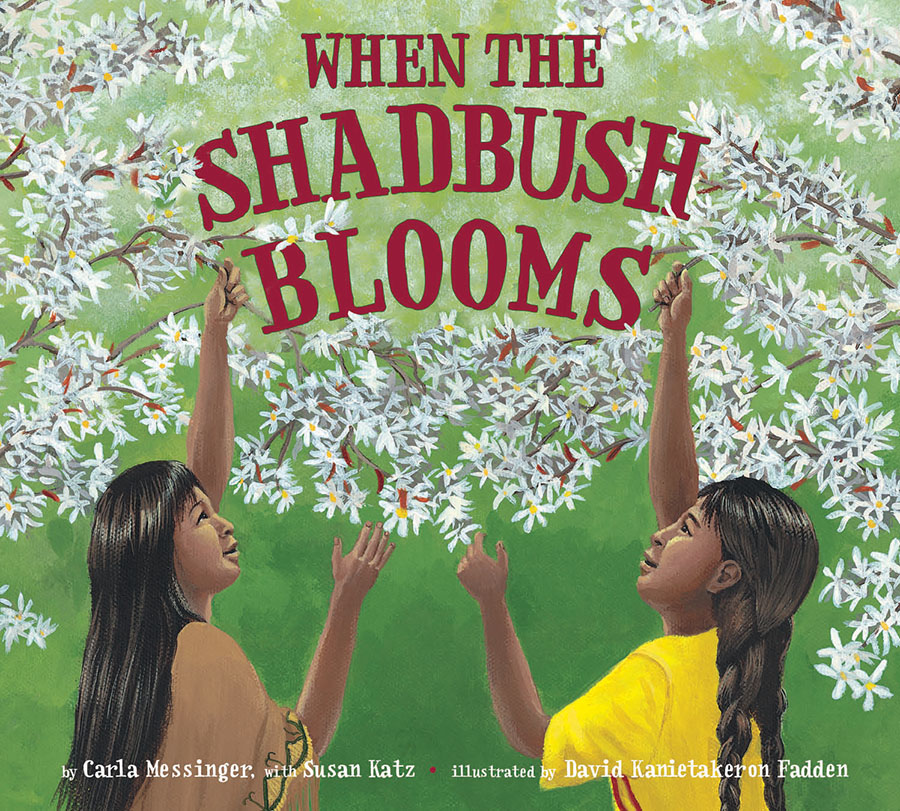
The past few weeks have been wild in my corner of the world, but I’m thrilled to say that I’ve found a gem to share with you all today. When the Shadbush Blooms, written by Carla Messinger and Susan Katz with illustrations by David Kanietakeron Fadden, is a lovely picture book that takes us through a young Lenape girl’s year. This book was published in 2007 by Tricycle Press, but I’m sorry to say that I haven’t seen it until just now. Get ready for some major love on the various pieces of this book!
The Good Stuff
The Story
I came across this book when I was processing it for a hold. November is nearly upon us, so in library land this means that many places are getting ready for Native American Heritage Month. (My feelings about NAHM as a whole are too long to fit in a novel let alone a blog post, but I digress.) The nice thing about being an Indigenous librarian is that I can help nudge folks toward positive pieces of representation that are culturally specific and respectful of Indigenous history and stories. I’m so pleased that I get to add this book to my list of recommendations.
Starting off with the writing, there’s a lot to love! Messinger is Lenape, so she pulls from a knowledge of cultural history and activities to create the story of a young girl’s journey through a year. The activities she participates in are culturally specific and tied to specific times of the year, which is further reinforced by text in the upper corners of the page naming the months in both Lenape and English. I come from a lunar calendar culture myself, so seeing this was a joyful surprise! The text reinforces a connection to the past while being a part of the present – Messinger’s words skillfully communicate that these activities are not only things that our protagonist’s grandparents’ grandparents did, but something that she does with her family now. It’s far too common that informational texts about Indigenous peoples refer to us exclusively in the past, so seeing Messinger’s words reflect a connection to the past and present was another excellent element of the book. The art helps to reinforce this, which brings me to yelling about…
The Art
Fadden’s (Mohawk) work here is beautiful. I was surprised and touched by the clear care he took in illustrating Messinger’s story. His illustrations reinforce the message that Messinger is trying to send (and I’m so sorry for the unintended pun there). The page design features an illustration of the past and of the present, reflecting the same activity being done by different generations of the same family. The family connections, the joy, and the connection to the land and seasons is clear on both pages and in both time periods. When hollering at a colleague about how much I loved this book, I simply had to show them because trying to describe it was too difficult in the moment – when they saw it, they knew exactly what I meant. Fadden’s illustrations deftly show how it feels to participate in traditional activities in kinship with the land around you, and it was a shot to the heart on a regular Wednesday morning.
See how cute this GIF is? That’s how this book made me feel.
In Summary
This is another wonderful, culturally specific book, and I’m so glad I found it on my library’s shelves. This book is highly recommended! You can find it online at Lee and Low. As always, gichi miigwetch for reading!

 Mzinigan Mshiiken