Introduction
Once, long ago, Mother Grizzly Bear…had two cubs she loved dearly. …One day the grizzly went to…the Merced. She took her cubs with her to catch rainbow trout and search for berries. However, the playful cubs waded into the water and splashed each other and scared away all the fish. Their mother gently scolded them, then sent them to hunt for berries.
p. 2
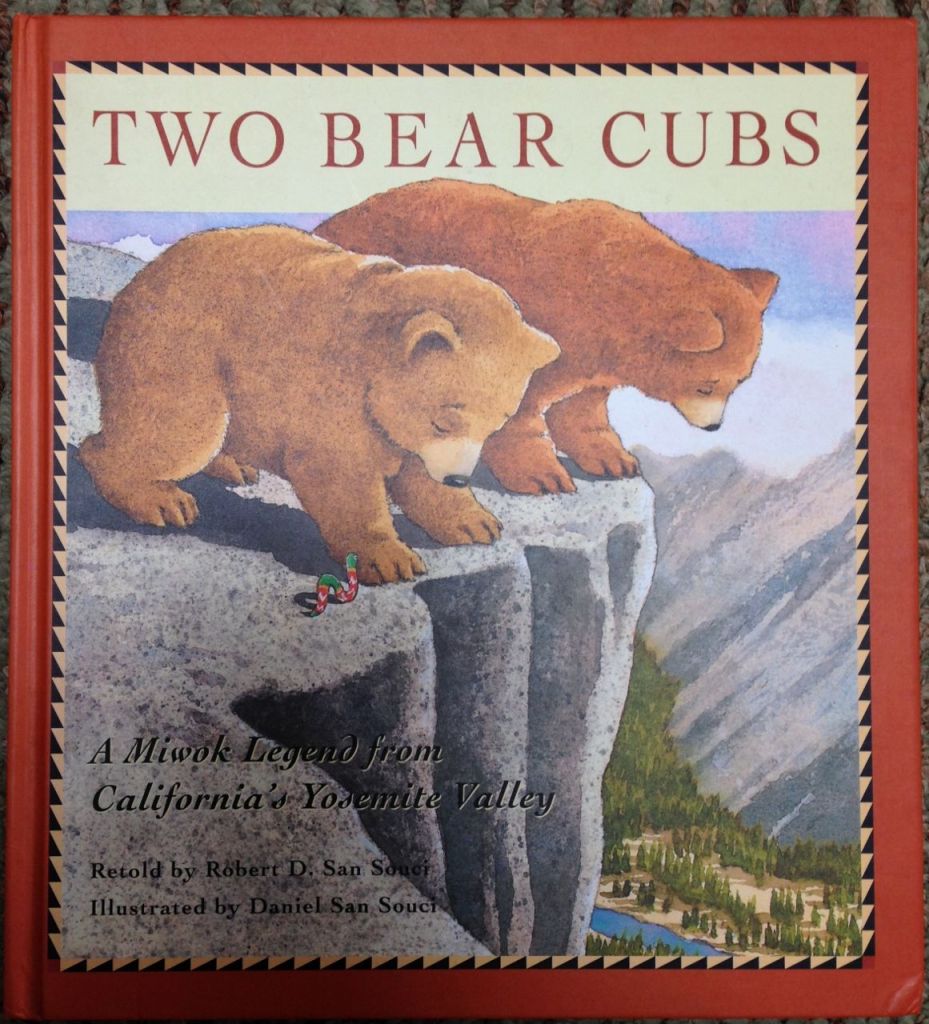
Two Bear Cubs is a picture book published in 1997, written by Robert D. San Souci and illustrated by Daniel San Souci. The subtitle calls it a Miwok legend from California’s Yosemite Valley, but it’s more accurately a commodified retelling of a retelling of a retelling that is only labeled with an Indigenous nation for monetization purposes. Buckle in, friends, this is one of my first not recommended books!
The Not-So-Good Stuff
As I mentioned in an earlier post, tis the season for Native American Heritage Month preparations. In my own work at the library, I’m using it as a means of starting conversations about the prevalence of “Anacostia” as a name but not as a people as well as introducing my library’s community to my tribe’s language and culture in a respectful way. A lot of this work is extremely intentional because books like this one are on our shelves and are often taken for fact when they are a harmful fiction. When I first read this book, it didn’t sit right with me but I couldn’t articulate exactly why. Another book on our shelves that helped me to crystalize my own thoughts is A Broken Flute edited by Doris Seale and Beverly Slapin. This is a collection of poems, essays, reviews, and stories about Indigenous representation and experience in books for children. I’ll draw on the review of Two Bear Cubs from A Broken Flute below to help explain my thoughts, but I highly recommend you pick up a copy of A Broken Flute for yourself if you work with children’s literature at all.
Okay, back to Two Bear Cubs.
The Story
My heart sank when I opened up this book for the first time and saw San Souci’s introduction to the work. I know that the 90’s aren’t necessarily a paragon of cultural sensitivity, but from the first page the text comes across as condescending:
Many snows have come and gone since this story was first told by the Miwok, whose name means “people” or “humans.” They lived in a place they called Ah-wah’-nee, which is now known as Yosemite Valley. The Miwok believe that in the old days, the residents of Ah-wah’-nee were “animal people” – creatures that were part animal and part human.
p. 1
Oof! This massive oversimplification has almost surely made it into someone’s understanding of the Miwuk people, and that’s a shame. In Robette Dias’ (Karuk) review of this book for A Broken Flute, she points out that the narrative is designed to appeal to non-Native young people. None of the characters actually read as Indigenous, but instead read as white characters in a play based on a story they barely understand and isn’t theirs to tell. Their capacities are limited to their animal attributes and are wildly oversimplified in the same way as the introduction, so despite supposedly being ‘part animal and part human’, the author’s description of them reduces them to caricatures.
The Art
Speaking of caricatures, the art of this book unfortunately reinforces a lot of these points. San Souci depicts the animals playing dress-up, with characters meant to be read as female wearing fringed skirts and pearl necklaces. ‘Male’ characters wear loincloths, and the ones that don’t easily wear a garment of this type either feature a Southwestern-y pattern (the measuring worm) or an abalone shell on a leather string (the red-tailed hawk) (Dias, p. 377). Although the art is technically well-executed, it reinforces harmful stereotypes of what Miwuk people might have worn pre-contact and in a way that’s more reminiscent of the Flintstones than of actual living humans.
In Summary
Whew, this was a spicy review. Even though this was published around 30 years ago, we can and should hold our children’s literature to a high standard of representation. As I said in the introduction, this book is absolutely not recommended. Instead, pick up A Broken Flute from Birchbark Press. As always, gichi miigwech for reading!
Also, a quick personal note: sadly, the Joint Conference of Librarians of Color 2022 was canceled due to Hurricane Ian. Here’s the list of mutual aid organizations doing recovery work in Florida and Cuba they sent out to would-be attendees. If you have a bit to spare, please send it their way!

 Mzinigan Mshiiken