
Introduction
The land loves us back. She loves us with beans and tomatoes, with corn and blackberries and birdsongs. She provides for us and teaches us to provide for ourselves.
Chapter ‘Epiphany in the Beans’
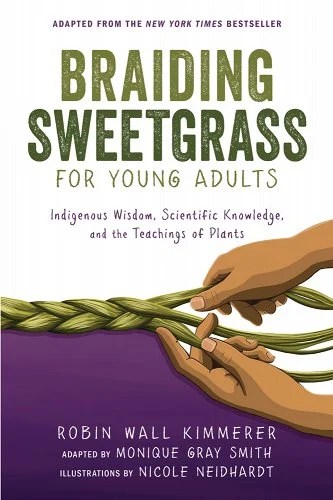
Braiding Sweetgrass took the world by storm back in 2015. Robin Wall Kimmerer’s collection of essays from her perspective from the crossroads of her identities as an Indigenous woman, mother, and botanist (to name only a few) was a joy to read and to absorb. Now, Monique Gray Smith has adapted Kimmerer’s book with illustrations from Nicole Neidhardt for young adults. I wasn’t sure how it would go but I am so glad that an early copy from NetGalley let me find out. This is a new piece of essential reading that flawlessly combines positive and healthy land stewardship ideas with hard science to back it up, all spoken in an unshakeable Indigenous voice. Let’s get in to what exactly makes this book so good.
The Good Stuff
A lot of folks have already written a lot of kind, accurate things about the original collection. I don’t think it’s an exaggeration to say that Kimmerer’s emergence with Braiding Sweetgrass was a shot in the heart for a lot of folks. I don’t want to get too far outside of the scope of this blog, but it’s important to mention that traditional ways of knowing and understanding the world have often been cast aside or ignored because they’re not backed up or confirmed with Western knowledge. There are parts of these traditional knowledgeways that shouldn’t be shared outside of their communities but for much of what is okay to share out, it’s usually ignored. The chapter about the student studying how sweetgrass thrives when in relationship with sweetgrass basketmakers is a perfect example of this.
Braiding Sweetgrass and this adaptation of it for young adults is a wonderful way of bringing those two paths together to make a more whole understanding of the world around us. Smith’s adaptation in particular is really wonderful in this regard because it finds a way to blend those understandings together in a way that supports both of them instead of replacing one or the other. The questions and pullquotes throughout the text are meant to highlight the ways in which Indigenous understandings of land stewardship and relationality can lead to a more fulfilling life as well as a more holistic understanding of plant science. Numerous chapters drive home this point in different yet similar ways – I’m sure you will find your favorite too when you read it!
Having read the original as well, I can’t emphasize enough how lovely this adaptation is. Smith’s ability to bring the essays to young adults without condescension or watering down is masterful. Those same questions and pullquotes I mentioned serve really well to bring little moments throughout the text to pause and reflect on how the content of the essays can be brought to life by the reader. I know that I’m massively gushing at this point, but I have to say here too that I am very much looking forward to conducting programming around the essays in this book when it hits our shelves.
As an side, it was a bit of a shock to realize that some of the folks I grew up around were mentioned by name in this book! I guess I didn’t read the original as carefully as I should have, but John Pigeon was in a drum with my dad when I was a kid. It was a huge moment of joy to see him mentioned and for his teachings to be written about so beautifully. I’m glad he and his family get the recognition they deserve in these books.
The Art
Neidhardt’s illustrations are pitch-perfect additions to the text of this book. In the same way that different methods of emphasizing text are used to give the reader a break for reflection and knowledge synthesis, the illustrations serve the same purpose while literally illustrating and making clear the ideas that Kimmerer and Smith are trying to convey. Anishinaabe-style abstract pieces along with photos and illustrations of seeds or root systems or whatever is happening in the text are a lovely way to give the eye a break but also to give a visual element to what Kimmerer and Smith are trying to say.
In Summary
I know this is probably a bit longer than usual, but I truly love this book! I think it’s another one that manages to be relevant and timely and is expertly adapted by Smith for younger readers. I really can’t wait for it to hit our shelves so that I can start recommending it right away. This book along with the original are highly recommended.
You can find Braiding Sweetgrass for Young Adults at the publisher’s site here. As always, gichi miigwech for reading!

 Mzinigan Mshiiken