
Introduction
One of the cool things about working in the main branch of my library is that our shelves serve not only as a gigantic browsing collection for the public but also as a repository of slightly older, not-as-popular books. This is cool for a lot of reasons, but sometimes it leads to discovering things that are factually inaccurate but kept anyway for ‘historical value’. (I have a lot of feelings about this but don’t want to write a novel.) Shingebiss: An Ojibwe Tale is one of these, written by Nancy Van Laan and illustrated by Betsy Bowen all the way back in 1997, which is not necessarily known as a time of complete cross-cultural understanding. Let’s get into this below.
The Not-So-Good Stuff
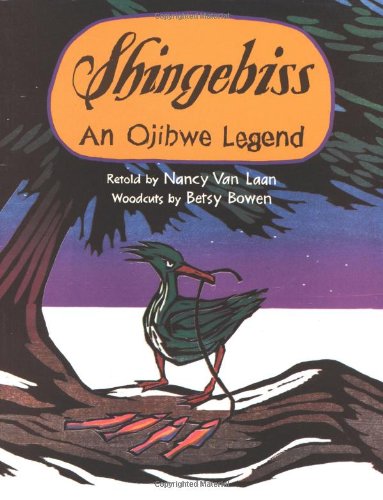
In this book, we are introduced to Shingebiss, who is a merganser duck. He lives in a community and fishes regularly for his food. One day, though, Lake Superior freezes over and Shingebiss must face Winter Maker in order to unfreeze the fish for his food.
I’m wondering if you could hear the sarcasm in my text…
At first I thought this book was great. I’m always a little suspect of nonNative authors writing Native stories, but this one seemed legit and even included back matter from Van Laan indicating that she approached an elder of the Grand Portage Chippewa Band with gifts and tobacco in exchange for an “understanding” of the story.
That’s all well and good, but diving deeper into it, this book is based on a retelling by Henry Schoolcraft. If you’re not familiar with him, here’s a link to his Wikipedia page. Functionally he was an early colonizer in what’s known today as Michigan who married an Jane Johnston, an Ojibwe writer who taught Schoolcraft the language, and studied stories from his in-laws. After Jane passed away, he remarried to a white woman from a slave-owning family who alienated his children from his first marriage by being extraordinarily racist. Gross!
Schoolcraft’s paternalistic view of the people of his first wife is threaded throughout how this story is told among the many stories he wrote as an Indian Agent. As historical record these things are important but must be interrogated as stories told through a colonizer’s lens. Therefore, uncritically publishing these things as stories for children without that work perpetuates fundamental, continuing misunderstandings of the story’s original tellers. I’m not just salty because I’m also Anishinaabe, but because this could have been cool and instead it’s kind of like a retelling of a retelling of something heard through construction noise next door.
There’s a bit more to say here, but it’s said effectively in A Broken Flute, edited by Doris Seale and Beverly Slapin. Once again, please check out this book for more voices discussing this book and many others like it. The link above takes you to Rowman & Littlefield’s site where you can purchase it, although there are other places on the internet that have it if the price point is too steep.
In Summary
As always, I’m going to be a bigger proponent of Indigenous stories written by Indigenous people that don’t come from paternalistic jerks. This book is not recommended.
Shingebiss: An Ojibwe Legend is written by Nancy Van Laan and illustrated by Betsy Bowen. It’s published by Clarion Books, an imprint of HarperCollins Publishers. (Support the HarperCollins Union!) You can find Shingebiss as an ebook on HarperCollins’ site, linked here. You can find information about the HarperCollins Union’s efforts here. As always, gichi miigwech for reading!


 Mzinigan Mshiiken