
Introduction
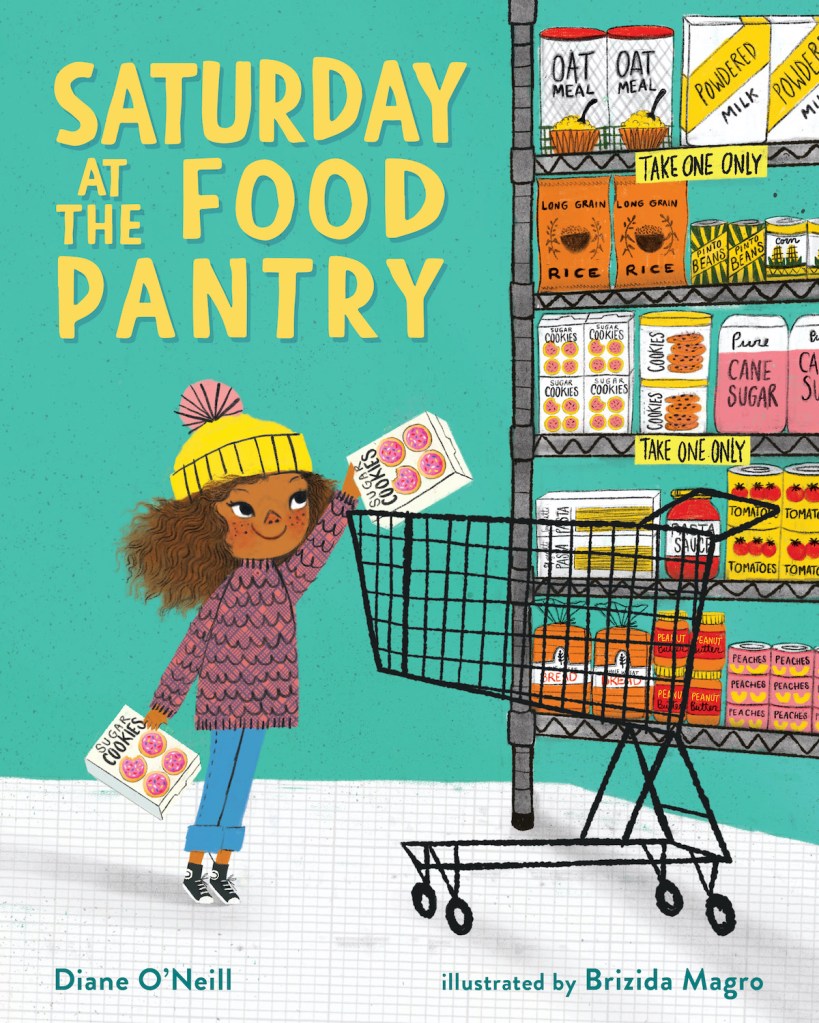
I recently came across this book on our shelves while pulling it for a hold elsewhere in the system. I had never seen it before and had to read it immediately – what a lovely, important book. Saturday at the Food Pantry, written by Diane O’Neill and illustrated by Brizida Magro, is about a young girl’s journey to the food pantry with her mom one Saturday. She doesn’t realize there’s anything shameful or bad about it until she runs into a classmate who is not-so-happy to see her. This book focuses on food insecurity and its many forms while encouraging kids that getting a little help sometimes is nothing to be ashamed about. Let’s dive in below.
The Good Stuff
The Story
This book was such a lovely surprise! Surprising in that I hadn’t realized there was a recently-published book like this available for our patrons on our shelves already. This book and others like it are critical because food insecurity is a major issue across the United States and many children, families, and adults rely on services like food pantries and food assistance programs to feed themselves. In terms of statistics, the USDA’s Economic Research Service (ERS) monitors food security in the United States with an annual survey. The data from 2021 reveal that 32.1% of households living at and below the poverty line are food insecure, with single-parent households food insecurity rates being substantially higher than that of other household types.
What this means for the libraries as third spaces between home and school is that we should be safe spaces for kids experiencing various circumstances like food insecurity. I’m only going to get on my soapbox a little bit here – being hungry or being in another kind of ‘survival mode’ means that you’re not able to follow directions or may act out of turn. This makes perfect sense and is even a socially acceptable thing – adults call it being ‘hangry’! If we want to be truly safe spaces for children and families, we have to be able to accept kids where they’re at even if it means seeing behaviors that go against policies. If you’re in a position to do so, learn about and advocate for trauma-informed practice in your library. (The link goes to the American Library Association’s book on trauma-informed library services. This one goes to the workbook from the Public Library Association about the same.)
Okay, back to this specific book. What I love in particular about this story is that Molly, her mom, and her friend navigate going to the food pantry together. The specific refrain that appears repeatedly throughout the book is “everyone needs help sometimes”. What a beautiful way to destigmatize getting help! O’Neill’s characters support each other even when they’re doubting or unsure – Molly convinces her classmate Caitlin to color with her and cheer up the line of people waiting for the food pantry. Later when Molly’s mom tells her to put back the boxed sugar cookie mix, a food pantry employee kindly hands it back to her with a remix of the key line, “everybody deserves a treat”. The story ends with Molly and her mom eating a meal with Caitlin and her gran using items from the food pantry – including the sugar cookies as a treat.
Be still, my heart! O’Neill’s emphasis on building community, destigmatizing food assistance, and nonjudgement is truly lovely. We get hints of Molly and Caitlin’s specific circumstances as well, although the primary emphasis is on the people getting help rather than their reasons for needing help. There are many other wonderful tidbits throughout the story, but I won’t give them away – do yourself a favor and check this book out for yourself.
The Art
Brizida Magro’s art is a beautiful accompaniment to O’Neill’s story. Magro’s efforts to show a diversity of races, body types, gender presentations, and ages emphasizes O’Neill’s point that everyone needs help sometimes. There are no bad representations and no judgments present in the depiction of the food pantry. Instead, we see it through Molly’s eyes, as a tidy, well-kept place with kind staff that offers a plethora of things to help make delicious food.
Another important note: no one’s race is explicitly stated. Molly herself has brown skin, her mom has lighter skin, and Caitlin and her gran have white skin. None of them are out-of-place in the food pantry line – Magro has clearly put a lot of thought into how she wanted to depict this story and it shows. All of this along with the informative illustrations of what might be found on a food pantry shelf creates not only a sweet story but an informative one. It’s really an excellent way to emphasize O’Neill’s message that food insecurity doesn’t target one household over another and that everyone deserves to eat good food.
In Summary
I know I’m gushing about this book, but this is an issue that hits very close to home for me. I’m deeply hopeful that it helps even just one child feel less ashamed of getting help and I’m going to recommend it to everyone I know. For extra super-duper clarity: this book is highly recommended.
Saturday at the Food Pantry is written by Diane O’Neill and illustrated by Brizida Magro. It’s published by Albert Whitman and Company, and you can find it on their site linked here. As always, gichi miigwech for reading!

 Mzinigan Mshiiken