
Introduction
Where I come from,
p. 27
Cherokee people are everywhere.
But here, no one sees the Cherokee in me
at all.
Doesn’t seem like anyone knows
there are Native people
living, working, and breathing in Rye,
in all these other cities,
and in Washington, DC.
Welcome back, friends! Today’s book is a special one. I first encountered it at ALA Annual 2023 in Chicago and was super-geeked to meet the authors while they promoted it! They were handing out signed ARCs. I was lucky to grab one for myself and knew it was going to be a tough but necessary read.
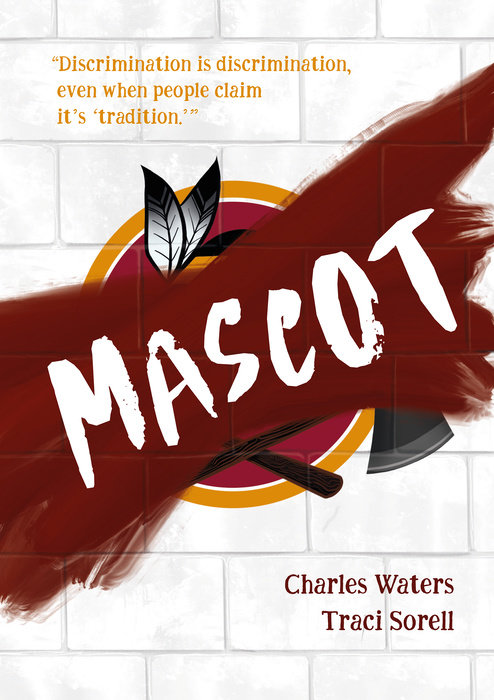
Mascot is a novel written in verse by Traci Sorrell and Charles Waters. This book follows the perspectives of several different middle schoolers through a school year in the fictional town of Rye, Virginia. The story focuses on how the kids and the adults in their lives are affected by Rye High School’s team name and mascot.
In Rye, Virginia, just outside Washington, DC, people work hard, kids go to school, and football is big on Friday nights. An eighth-grade English teacher creates an assignment for her class to debate whether Rye’s mascot should stay or change. Now six middle schoolers–-all with different backgrounds and beliefs–-get involved in the contentious issue that already has the suburb turned upside down with everyone choosing sides and arguments getting ugly.
Publisher’s website
I’ve been a big fan of Traci’s work for a while now and wasn’t familiar with Waters before this book – needless to say, this has turned me into a big fan of his as well! I’m really excited to talk more about what makes this book great below.
The Good Stuff
Mascot follows the story of six middle schoolers getting ready for high school. Callie, Franklin, Priya, Sean, Tessa, and Luis are our main voices throughout the story, with honors English teacher Ms. Williams as a connective voice. Each student has a different background and set of experiences that informs how they interact with events in the story and each other. Callie is Cherokee and Black; she reacts over the course of the story to the mascot of the school to which she’s newly transferred. The other characters have lived in the town of Rye for longer than Callie; Callie’s arrival seems to be the catalyst for big changes to not only the school’s mascot, but to how other kids and adults understand identity and community.
This book is absolutely incredible, y’all. I’ll mention Callie the most because she is the character most directly harmed by Rye’s racist mascot: the early poems from her perspective describe physical reactions and feelings of sickness. Some of the other characters empathize with her perspective – namely Priya and Tessa – while others start the story by fully embracing the school’s mascot. The various pieces of prose from each character are very evenly written, though, so you go through the story understanding everyone’s perspective clearly and understanding why and how they change.
This is especially important because Callie is not the only character of color in the story! Franklin, Priya, and Luis are also from different nonwhite backgrounds, and critically this does not mean they automatically agree with Callie. I was such a fan of this aspect of the story because it reflects the mascot issue in a real way. Imagine my shock when I first moved to the DC metro area and realized that the Washington football team wasn’t in Washington state! I hadn’t ever imagined that it was in a place like DC that such a racist thing could be socially acceptable and even celebrated. It was an awful thing to realize that I lived very close to a racist caricature that I would have to see and be subjected to every fall for the foreseeable future. The mascot finally changing was an extraordinary relief (and I’m sure it was for my colleagues too, who didn’t have to listen to me screech about it anymore!).
Although that mascot has changed, this book is still extremely relevant. Rye’s mascot may be the central issue, but Sorrell and Waters skillfully weave the characters’ intersectional identities. Each of the kids and their families come from different ethnic and socio-economic backgrounds which clearly inform how they handle the issues presented in the book. The prose is succinct while being powerful – you can’t help but feel genuinely for each of the kids as they navigate expanded understanding of the world around them. The ending further emphasizes this by deliberately not tying everything into a neat bow. The mascot may have been changed, but so too have the relationships between the characters as well as the characters themselves. It’s not neat and tidy! It makes me think of this quote:
Nonfiction is learning through information, and fiction is learning through imagination.
Celeste Ng
Mascot is a great way for readers of all backgrounds to experience different perspectives about an issue that is still relevant across the United States today. I highly encourage you to pick it up, to share it with people, and to maybe use this discussion guide while you do.
In Summary
As if I needed to say it – this book is highly recommended. If you like Kwame Alexander’s work in The Crossover or any of Jason Reynolds’ works, you’re going to love this one!
Mascot is written by Charles Waters and Traci Sorrell. It’s published by Charlesbridge, an imprint of Penguin Random House. You can find a link to purchase it here. As always, gichi miigwech for reading!

 Mzinigan Mshiiken