Phoenix didn’t have any friends who liked hockey, trucks, and bulldozers. He made friends with those who liked dolls and dancing too.
But sometimes, other kids made fun of Phoenix because he preferred dolls to trucks. They thought he was strange because he didn’t act like the rest of the boys in their class.
Unpaginated
Introduction
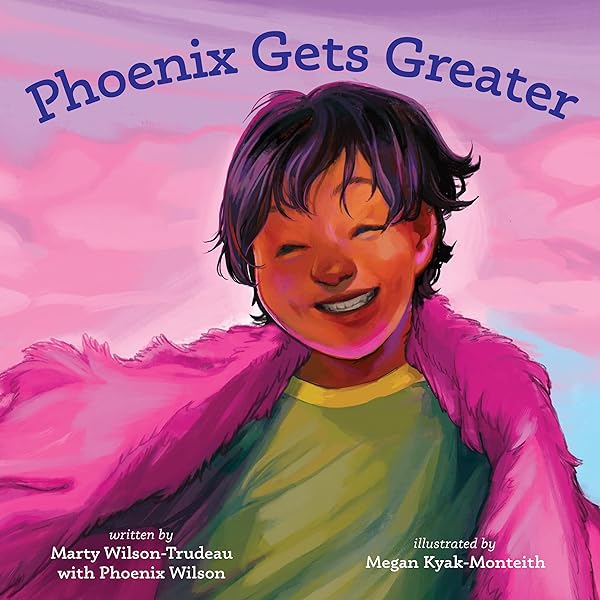
Aanii boozhoo nwiijkiwehnak! Today’s book has been on my TBR list for quite some time, and I was grateful to find it on my library’s shelves. Phoenix Gets Greater is a story based on Phoenix Wilson’s experiences as a child. From the Birchbark Books store page:
Phoenix loves to play with dolls and marvel at pretty fabrics. Most of all, he loves to dance–ballet, Pow Wow dancing, or just swirling and twirling around his house. Sometimes Phoenix gets picked on and he struggles with feeling different, but his mom and brother are proud of him. With their help, Phoenix learns about Two Spirit/Niizh Manidoowag people in Anishinaabe culture and just how special he is.
Based on the childhood experiences of her son, Phoenix, Marty Wilson-Trudeau demonstrates the difference that a loving and supportive family can make.
Birchbark Books store page for Phoenix Gets Greater
This book is really lovely and is an important addition to children’s literature around both Indigenous people and LGBTQIA+ people! Let’s dive in below.
The Good Stuff
The summary above covers the main points of the book – Phoenix is born to a loving mother and brother who watch him grow into a healthy kid after a rough start. He grows into a kiddo who loves things typically classified as feminine. This doesn’t only mean dolls, pink things, or frills, but also extends to a typically feminine powwow dance style. Although his family loves him for who he is, he encounters others who think that he’s strange. He stops doing the things he loves until he bravely comes out to his family. After they affirm him and tell him how much they love him, Phoenix is once again happy enough to dance and express himself in the way that makes him happiest.
I’m summarizing hard, but I’m hoping this encourages you to read the book for yourself! Wilson-Trudeau does a beautiful job of writing the story in a prosiac way. She gives the story something of a dream-like quality; Kyak-Monteith’s art furthers that with gentle, saturated illustrations. The first page of the story features Phoenix as a baby, and he is the squishiest lil Anishinaabe baby you have ever seen. If nothing else, you have to read this book for the illustration of Phoenix and his mom in their Halloween costumes – my blood sugar shoots through the roof just looking at it! What’s really important as well about this story and the illustrations is that they are completely, unapologetically Indigenous. I want to call this out here because a lot of Indigenous children’s literature used to be written in what I think of as the niinwi style.
In Anishinaabemowin, there are seven pronouns – the extra one from Latin-based languages you might know comes from two kinds of ‘we’. Niinwi is “we, excluding the person we’re talking to”. Giinwi describes “we, including the person we’re talking to”. When I use niinwi to describe stories, I’m thinking of stories written by or about Indigenous people geared toward a non-Indigenous audience. This is an important way to write some stories so that we can share knowledge or information without violating cultural protocols. Many times, these stories act as the reader’s first introduction to Indigenous people.
The beautiful thing about Phoenix Gets Greater is that it’s written in a giinwi style: “us, including the person we’re talking to”. I felt a very similar way when reading Firekeeper’s Daughter. This was a story written about an Anishinaabe kiddo in a way that doesn’t assume the reader is non-Indigenous. In fact, there are references in the book to stories and teachings that Indigenous people will likely be familiar with without explanation. That’s a great and important feeling, and to me, it represents a deep inclusion that has previously been difficult to find. It’s not meant to educate non-Indigenous people.
In Summary
I’m hoping my niinwi / giinwi style comparisons make sense – because of that giinwi style of writing and the story of a kiddo growing into himself, this book is highly recommended.
Phoenix Gets Greater is written by Marty Wilson-Trudeau (Anishinaabe) with Phoenix Wilson (Anishinaabe). It’s illustrated by Megan Kyak-Monteith (Inuk). Phoenix Gets Greater is published by Second Story Press. You can find a link to buy it from Birchbark Books here. As always, gichi miigwech for reading!

 Mzinigan Mshiiken