

Alice rocked back on her heels and sighed with satisfaction. She had taken this one thing, this one most important thing in the House – for everyone knows that the fireplace is the heart of any house – and fixed something broken and made it like new. There was no better feeling in the world.
Chapter 4
Introduction
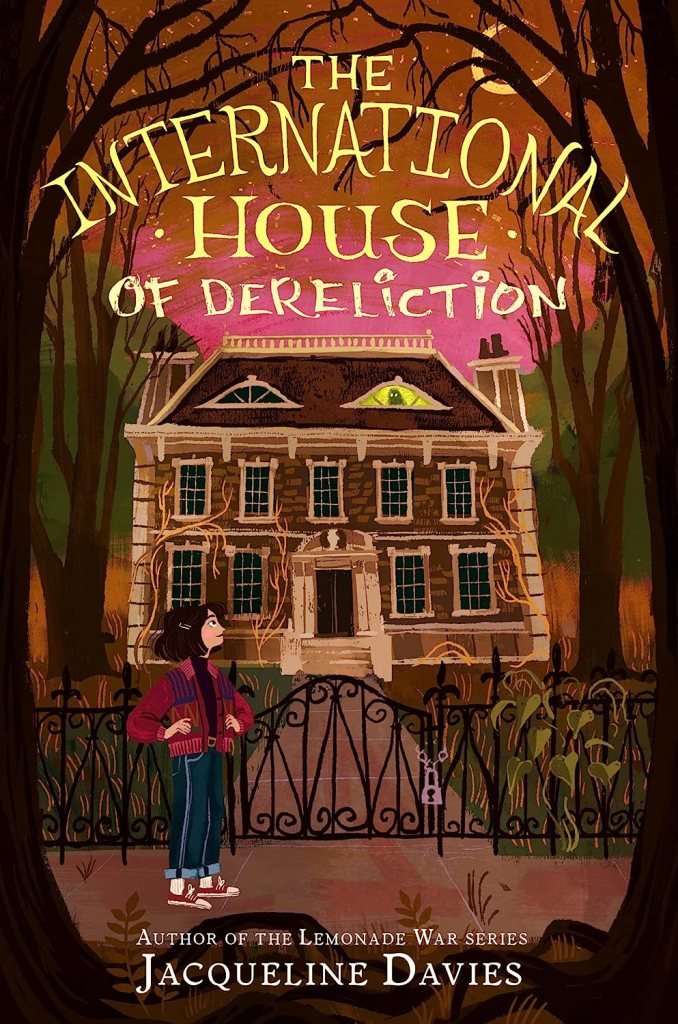
Welcome back! This week we’re looking at Jacqueline Davies’ new middle grade novel The International House of Dereliction. Although the title may seem very scary, this book is actually only a little spooky while being a very sweet story about relationships and saying goodbye. In this story we follow Alice Cannoli-Potchnik as she moves into a new house and answers the call of the house next door. From the NetGalley page:
Ten-year-old Alice is moving for the eleventh time.
She’s lived in so many houses, each more broken than the last, that home to Alice is nothing more than a place you fix and then a place you leave. After all, who needs a permanent home when you’re a whiz at fixing things?
But when Alice arrives at her new home, she can’t take her eyes off the house next door, the stately dark house that hulked in the dimming light. The once-grand mansion, now dilapidated and condemned, beckons Alice; it’s the perfect new repair job!
As Alice begins to restore the House to its former splendor, she senses strange presences. Is there a heartbeat coming from the House’s walls? Is someone looking at her? Soon she realizes she’s not alone. Three ghosts have been watching, and they need Alice’s help to solve their unfinished business.
Will Alice be able to unravel the mysteries of the House and find her forever home . . . before it’s too late?
NetGalley page for The International House of Dereliction
It’s an exciting and inviting premise! Let’s dive in to the story below.
The Good Stuff
You might be familiar with Davies’ work as the author of The Lemonade War series. If you’re not, however, this is a wonderful introduction to how she writes for and communicates with young readers. Her canon of middle grade fiction is extensive – even if this book isn’t your style, you will very likely find another of hers that you like better. I preface talking about International House of Dereliction with this background information because it’s clear that Davies has a nuanced way of talking to young readers without talking down to them while telling a sweet and fulfilling story.
Like the blurb mentions above, this book follows Alice Cannoli-Potchnik. She is the child of the Cannoli and Potchnik families, each of which have specific and unique characteristics that Alice feels, names, and interacts with throughout the story. The Cannoli side is credited with a fierce academic rigor while the Potchnik side is the origin of Alice’s ability to fix nearly everything. The story reinforces throughout that this is a combination of nature and nuture – even while Alice keeps secrets while fixing up the House next door, her parents consistently display a fierce love for her even when they don’t understand her actions. (This makes for a thrilling conclusion to the book!) Alice’s parents drive home the importance of family and pass on their stories using carefully-preserved pictures of ancestors from both sides of the family.
The emphasis on remembering and ‘doing right by our relatives’ sparks the main plot of the book. Alice’s parents are moved around from house to house on her mother’s college campus because of their propensity to fix up wherever they’re living. The story kicks off when they swear not to fix anything in their newest house until they can guarantee that they won’t be moved again. Alice scratches the ‘Potchnik itch’ driving her to fix broken things by going to the house next door: if they’re not living there, then it shouldn’t be a problem to fix it up, right? She rejuvenates the house by fixing the hearth tiles first and then meets the House’s spectral residents because of her good deeds.
I’ve been rambling for a minute now, and for good reason. This book is so wholesome! Many of my recent reference interviews have asked for stories that are scary-but-not-too-scary for readers that are daring and ready for a challenge but sensitive to violence or tough topics. Davies really threads the needle here with House. I’m also a huge fan of how Davies uses language throughout the book. Davies peppers unusual vocabulary throughout the story; it’s infrequent enough so as to spark the reader’s curiosity without being ham-fisted or difficult to parse. My library system has recently made an effort to focus more on newly independent readers, so I’m appreciative of Davies’ language being accessible to kids and adults while allowing the story to flow naturally. It reminds me of A Series of Unfortunate Events in a good way.
One last thing I want to note, though, is that this book is another heavily white-centered story. Alice’s family histories are hinted to be deeply Eastern European in origin and, while this isn’t necessarily a problem, relies heavily on the assumption that the reader is white or heavily ensconced in white culture. This isn’t a bad thing by itself, but it would have been nice if we had a little more information on Alice’s background given that the story focuses heavily on her family history and connection to her ancestors.
In Summary
Overall, this book was a very fun read. My younger patrons looking for a not-too-spooky ghost story are going to enjoy this, although I’ll look forward to providing thorough reference information about it as well. Mixed feelings and reliance on the dominant narrative move me to recommend this book overall.
The International House of Dereliction is written by Jacqueline Davies and published by Clarion Books, an imprint of HarperCollins Publishers. You can find a link to purchase it here. As always, gichi miigwech for reading!


 Mzinigan Mshiiken